
Most people don’t need a perfect plan.
They need a plan they can repeat.
The right training schedule depends on two things:
- Where you’re starting
- What season of life you’re in
This blog will help you figure out your number, step by step.
Step 1: Choose your “starting point”
Pick the description that fits you best right now.
A) “I’m not working out at all”
Or you’ve been off for months and you’re basically restarting.
Your best move: 2 days per week.
Why:
- It’s realistic.
- It fits into a busy schedule.
- It builds momentum without burnout.
Your goal right now is simple:
prove to yourself you can show up again.
B) “I work out sometimes, but it’s inconsistent”
You go through bursts, then fall off.
Life gets busy and workouts get skipped.
Your best move: start with 2 days per week for 4 weeks.
Not because you can’t do more.
Because consistency matters more than intensity.
Goal: 2 workouts every week for 4 straight weeks.
If you hit that, you’ve earned the next step.
C) “I’ve been pretty consistent already”
You strength train or do classes regularly.
You’re not perfect, but you’re in a groove.
Your best move: 3 days per week.
This is the sweet spot for most people:
- Strength builds
- Muscle builds
- Energy improves
- Body composition changes
- You still have a life
Most people can live here for a long time and keep making progress.
Step 2: Decide what you want from training right now
This is where people get stuck.
So let’s make it easy.
Pick the goal that matters most right now:
Goal 1: “I want to feel better and get back in shape”
This is a lifestyle goal.
2–3 days per week is perfect.
Goal 2: “I want to lose weight”
Weight loss is mostly driven by consistency, daily movement, and nutrition.
2–3 days per week is enough for training, as long as:
- You’re consistent
- You’re walking regularly
- Your nutrition is on track
Goal 3: “I want to build serious strength and performance”
Performance goals usually require more training volume.
3–5 days per week depending on the goal and recovery.
But performance only works if your life can support it.
Step 3: Check your schedule reality (this is the part people skip)
Before you commit to a number, do this:
Look at your week.
Ask:
- Which days are most predictable?
- Which days are always chaotic?
- What time of day is most realistic for me?
Now pick your training days and protect them.
Quick rule:
If you can’t name the days and times, it’s not a plan.
Examples:
- “Mon + Thurs at 6am”
- “Tues + Fri at 4:30pm”
- “Mon/Wed/Fri after work”
Step 4: Use the “Minimum Effective Dose” rule
This is the rule that keeps you consistent long-term.
Pick the lowest number of sessions you can hit even when life is busy.
That’s your baseline.
For most people:
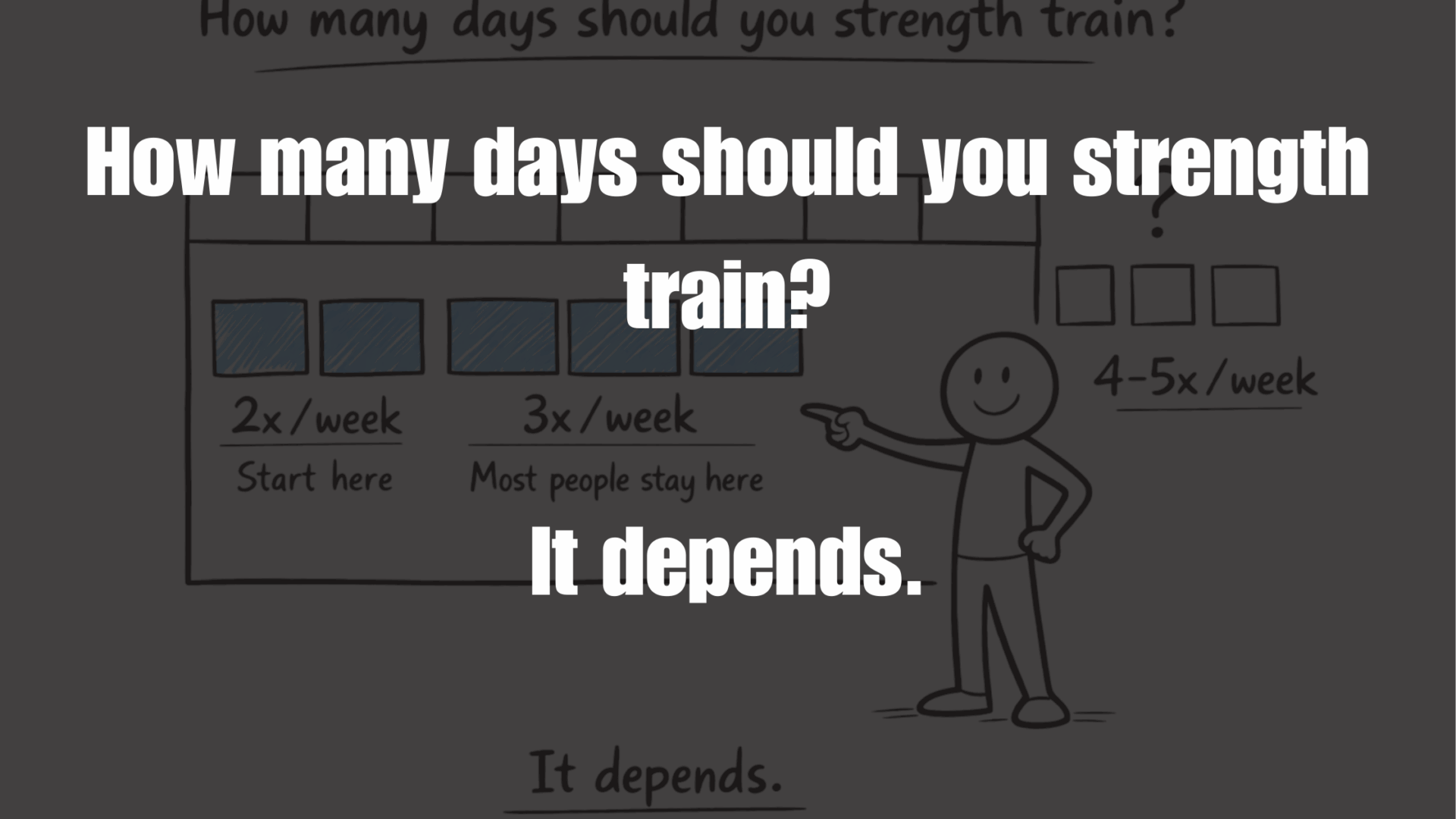
- 2 days/week = baseline
- 3 days/week = progress
- 4–5 days/week = performance (when life allows it)
Your baseline isn’t what you do on your best week.
It’s what you do on a normal week.
Step 5: Give it 4 weeks, then reassess
Don’t change your plan every Monday.
Run the plan for 4 weeks.
At the end, ask:
- Did I hit my sessions most weeks?
- Do I feel better?
- Am I recovering well?
- Is this sustainable?
If you’re missing workouts:
Don’t add more.
Drop to a number you can own.
If you’re consistent and feeling good:
You can consider adding a day.
Step 6: Know when it’s time to do less (and why that’s okay)
This is important.
Some seasons of life are just heavier:
- Kids schedules
- Work deadlines
- Travel
- Family stress
- Poor sleep
- Health issues
During those seasons, it’s not failure to train less.
It’s smart.
Here’s the goal in a crazy season:
Don’t quit. Downshift.
If you normally train 3 days per week:
- Drop to 2 days per week for a month
If you normally train 4 days per week:
- Drop to 3 or even 2 for a few weeks
If you can’t make it to the gym:
- Do 20 minutes at home twice per week
- Or do one full-body session and walk more
Keeping the habit alive matters.
Because the hardest part isn’t getting strong.
It’s starting over again after you stop.
Step 7: Use this simple decision chart
If you want the whole answer in one place:
Start here:
- 0–1 days/week right now → train 2 days/week
- Somewhat consistent → train 2 days/week for 4 weeks, then decide
- Consistent already → train 3 days/week
Then adjust based on goals:
- Lifestyle / feel better → 2–3 days/week
- Lose weight → 2–3 days/week + walking + nutrition
- Performance → 3–5 days/week (only if life supports it)
And adjust based on season:
- Busy season → drop 1 day, keep the habit
- Normal season → build consistency
- Open season → add volume if goals require it
The bottom line
The best plan isn’t the hardest one.
It’s the one you can stick to.
Start where you are.
Be consistent.
Reevaluate when it’s earned.
And if life gets crazy, it’s okay to do less.
Just don’t disappear.
If you want help figuring out your number and mapping out a plan you can actually follow, that’s exactly what we do at The Well.
Book your Free Intro here.


